


Planning a weekend barbecue requires knowing whether your fuel supply can handle the cook from start to finish. Few grilling mishaps cause more frustration than having burners sputter out while steaks or burgers are halfway done. Understanding how much propane is in a standard grill tank helps pitmasters calculate cooking runtime and avoid unexpected mid-cook trips to the store. A typical cylinder used on residential gas grills is rated for twenty pounds of liquefied petroleum gas, but the actual usable amount depends on whether you refill the cylinder locally or swap it at an exchange kiosk.
Whether you are managing a standalone gas grill or comparing fuel options for outdoor smokers, knowing your total fuel weight makes everyday heat management far simpler. Tank weight includes both the steel container itself and the liquid fuel stored under pressure inside. By mastering basic capacity numbers, tare weights, and pressure characteristics, you can keep your outdoor cooking station running smoothly and safely every grilling season.


Understanding Standard Grill Propane Tank Capacity, Weight, and Runtime
A standard liquid propane cylinder designed for residential barbecue grills holds twenty pounds of fuel when completely filled to legal safety limits. That capacity equals approximately 4.7 gallons of liquid fuel, delivering enough thermal energy for numerous family meals and extended outdoor cooking sessions. However, the exact amount of propane waiting inside your cylinder often varies based on whether you swap the tank at an exchange kiosk or refill it at a certified station. Understanding these measurements prevents fuel surprises and ensures you extract maximum cooking performance from every cookout.
The Anatomy and Sizing of a Twenty-Pound Propane Cylinder
The familiar tank sitting beneath your backyard grill is officially categorized by the Department of Transportation as a twenty-pound LP gas cylinder. Manufacturers construct these durable containers from heavy-gauge welded steel or lightweight composite materials, designing them to safely withstand high internal vapor pressures. Each steel tank features a protective collar at the top that shields the main valve, alongside a welded foot ring at the base that provides stability on patio surfaces. A standardized Type 1 connection port ensures consistent compatibility across modern residential outdoor cooking appliances.
Every modern cylinder manufactured since 1998 incorporates a mandatory Overfill Prevention Device, commonly known as an OPD valve. You can identify an OPD valve easily by inspecting its distinct triangular handwheel, which differs sharply from older round or star-shaped knobs. Inside the tank, a buoyant float mechanism connects directly to this valve, automatically stopping the liquid flow when fuel reaches the legal eighty percent capacity threshold. Commercial filling stations are legally prohibited from refilling any portable cylinder that lacks this essential safety valve mechanism.
The eighty percent filling limit represents a vital federal safety standard rather than an arbitrary guideline. Liquid propane expands dramatically as ambient temperatures rise outside, requiring a remaining twenty percent vapor space to accommodate thermal expansion safely. Without this designated safety cushion, warming weather could cause extreme internal hydrostatic pressure, forcing the safety relief valve open and discharging flammable gas into the surrounding environment. Maintaining that vapor headroom ensures the internal pressure stays safely within the structural tolerances of the steel container.
Tank Exchange Kiosks Versus Certified Refill Stations
One of the most surprising facts for new grill owners is that retail exchange cages rarely provide a full twenty pounds of fuel. Most nationwide cylinder exchange services place exactly fifteen pounds of liquid propane into their pre-filled tanks. Companies adopted this fifteen-pound standard across the exchange industry to offset rising operational expenses while providing a generous safety margin during transport and outdoor storage. When you pick up a tank from an automated outdoor kiosk, you are receiving three-quarters of the cylinder total volumetric capacity.
In contrast, visiting a dedicated propane refilling station at an equipment rental yard, farm supply depot, or hardware store yields a full twenty-pound fill. Certified technicians place your tank onto a calibrated platform scale and pump liquid fuel until the scale balances at the true eighty percent limit. This distinction means a professionally refilled tank gives you five additional pounds of propane compared to a standard kiosk exchange. Those extra five pounds translate directly into several additional hours of active cooking time on your backyard grill.
Choosing between these two refueling methods involves weighing personal convenience against total fuel volume. Retail exchange cabinets outside grocery stores and home centers offer fast service and allow you to discard aged or rusty cylinders without inspection hassles. Dedicated refill stations, on the other hand, deliver roughly twenty-five percent more cooking gas per visit, making refills more cost-effective for frequent outdoor cooks. Evaluating how often you cook and how close you live to a bulk refilling facility helps determine the best approach for your household.
Understanding Tare Weight and Total Cylinder Weight
Determining how much fuel remains inside an opaque steel cylinder requires an understanding of tare weight. The term tare weight refers specifically to the weight of the completely empty tank before any fuel is added. Manufacturers stamp this measurement into the steel collar of the tank, where you will spot the letters TW followed by a number such as 16.6 or 17.0. Because each tank varies slightly during steel fabrication, checking the unique stamp on your specific collar gives you an exact baseline.
Most standard twenty-pound steel cylinders have an empty tare weight ranging between 16.5 and 17.5 pounds. To calculate the total weight of a full cylinder, you simply add the weight of the liquid propane to that stamped collar measurement. A completely filled twenty-pound cylinder placed on a scale will read approximately thirty-seven pounds, whereas a fifteen-pound exchange tank will weigh around thirty-two pounds. Recognizing these target numbers makes it easy to assess how much fuel you received as soon as you bring a tank home.
Weighing your tank on a regular household scale or hanging luggage scale provides the most reliable way to monitor remaining fuel levels. If you place a tank with a stamped tare weight of seventeen pounds onto a scale and the readout shows twenty-two pounds, you know with certainty that five pounds of propane remain. Subtracting the collar tare weight from the total scale reading eliminates guesswork and prevents running out of heat during delicate cooking sessions. Performing this simple calculation before starting an extended cook ensures uninterrupted heat.
Gallons, Pounds, and Thermal Energy Calculations
Understanding the relationship between propane weight and volume helps you evaluate fuel efficiency and consumption rates. At a standard reference temperature of sixty degrees Fahrenheit, liquid propane weighs approximately 4.24 pounds per gallon. This physical density constant allows you to convert easily between the volume dispensed by meter pumps and the weight measured on filling scales. Because volume shifts slightly as temperatures fluctuate, industrial suppliers always use temperature-compensated meters or gross weight scales to ensure precise measurements.
Applying this formula reveals that a fully refilled twenty-pound cylinder holds roughly 4.7 gallons of liquid propane. A fifteen-pound exchange cylinder, by comparison, contains approximately 3.54 gallons of usable fuel. When you purchase fuel from a commercial supplier that charges by the liquid gallon rather than a flat tank fee, this conversion ensures you pay accurately for the volume received. Knowing these numbers also clarifies how much actual liquid sits beneath the vapor layer in your cylinder.
Thermal energy potential provides another valuable dimension for calculating fuel value. One single gallon of liquid propane produces approximately 91,500 British Thermal Units of potential heat energy upon complete combustion. Consequently, a fifteen-pound cylinder supplies roughly 324,000 total BTUs of heat, while a full twenty-pound tank provides nearly 430,000 BTUs to power your outdoor burners. That substantial difference in stored thermal energy explains why refilled tanks last noticeably longer across multiple barbecue sessions.
How Long a Standard Propane Tank Lasts on Your Grill
The total operating hours you can expect from a single cylinder depend directly on your grill burner configuration and heat settings. Most mid-sized residential gas grills feature three or four primary burners rated between 30,000 and 45,000 total BTUs per hour at maximum output. When running all main burners on high, your cooking equipment consumes propane at its highest possible hourly rate. Ambient wind and chilly weather can also force burners to work harder, subtly increasing hourly gas consumption.
Dividing the total heat capacity of your tank by your grill hourly burner rating gives an accurate estimate of high-heat cooking runtime. A 30,000 BTU grill running at wide-open throttle will exhaust a fifteen-pound exchange cylinder in roughly 10.8 hours of continuous operation. That same cooking appliance connected to a full twenty-pound refilled tank will operate for more than fourteen hours before fuel pressure drops. Keep in mind that specialized searing burners or side burners add to this total consumption rate when ignited.
Because typical barbecue recipes rely on medium heat or indirect two-zone setups, actual cooking time is usually much longer. Running your burners on medium or low cuts fuel consumption substantially, often extending the life of a standard cylinder to between eighteen and twenty-five cooking hours. Quick weeknight grilling sessions like searing burgers or roasting poultry breasts use minimal fuel, allowing one tank to last for several months of casual family meals. Tracking your typical burner dial positions provides a realistic picture of your seasonal fuel consumption.
Mechanical and Gauge Monitoring: How Pressure Indicators Work
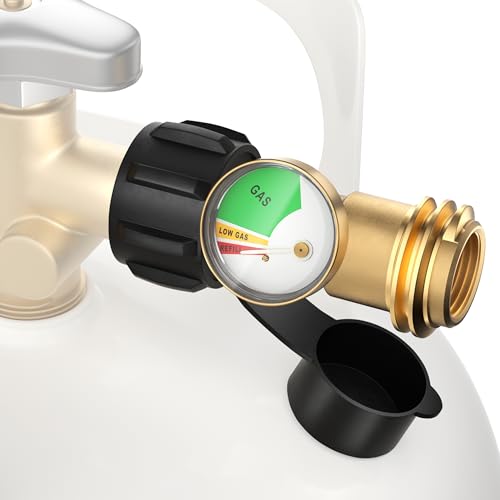
Many grill owners prefer visual indicators rather than disconnecting and lifting heavy cylinders onto a scale. Installing an inline fuel gauge between your tank valve and your grill regulator offers an accessible, tool-free way to monitor vapor conditions. The Type 1 Propane Tank Level Indicator (QCC1) from Grill Mark provides real-time tracking with an easy-to-read color-coded dial that attaches directly to standard Type 1 connections without specialized tools. Its clear visual zones allow cooks to assess fuel status at a glance before lighting burners.
Similarly, the GrillPro 80064 Gas Tank Gauge for QCC1 Liquid connects cleanly to standard Type 1 QCC1 cylinders to show whether gas levels are ample, dipping low, or ready for a refill. When considering this style of gauge, keep in mind that manufacturer notes specify it does not fit proprietary QuickConnect fittings found on select older Ducane or Weber models. These mechanical dials measure vapor pressure within the closed system to help you anticipate when your supply requires replenishment. Checking compatibility with your regulator hose fitting ensures a tight, leak-free seal.
It is helpful to recognize that inline pressure gauges read vapor pressure rather than the actual physical liquid level inside the steel container. Because propane vapor pressure changes significantly with fluctuations in ambient outdoor temperatures, readings will register lower on cold winter evenings than on hot summer afternoons. Despite this temperature-dependent behavior, a quality inline gauge serves as a dependable early warning device when your liquid reserve nears exhaustion. As liquid burns away and vapor pressure drops during active cooking, the needle shifts reliably toward the warning sector.
Alternative Fuel-Checking Methods: Water Pouring and Weight Testing
If you find yourself without an inline gauge or a scale, the warm water test provides a fast and reliable estimate of remaining fuel. Pour a pitcher of warm tap water down the exterior side of your closed propane cylinder. Then, carefully slide your bare hand down the wet steel surface from the collar toward the base ring. You will immediately feel a distinct temperature shift where the liquid pool begins.
The empty portion of the tank above the fuel line will feel warm to the touch because steel transfers heat rapidly from the water. In contrast, the section of the tank filled with liquid propane will feel noticeably cold, often developing an external line of condensation. Liquid propane absorbs heat energy quickly through the metal wall, creating a distinct temperature boundary that reveals your exact liquid level within seconds. This reliable physical method requires no tools and works on any steel cylinder regardless of age.
Another alternative involves using magnetic level indicators that attach to the lower exterior of the tank. These strips utilize temperature-sensitive liquid crystals that change color as propane vaporizes and cools the steel during active grill use. While magnetic strips are convenient, they only function while gas is flowing and the burners are actively drawing fuel. Combining magnetic indicators with occasional scale checks provides double confirmation when preparing for extended cookouts.
Critical Propane Safety, Handling, and Storage Standards
Propane is a safe and dependable fuel when managed properly, but fundamental safety rules must govern its storage and handling. Never store, operate, or light a propane cylinder indoors, inside an attached garage, or within any enclosed structure. Even leaving a garage door open does not provide adequate safety because leaking propane vapor is heavier than air and settles into low-lying corners, creating a severe fire and carbon monoxide hazard. Authoritative fire safety agencies consistently advise keeping all fuel cylinders strictly outdoors in well-ventilated locations.
Always position your gas grill and connected cylinder outdoors on a flat, non-combustible surface well away from building walls, overhangs, and wooden railings. Keep spare cylinders stored upright in a well-ventilated, shaded outdoor space away from electrical panels, dryer vents, and direct sunlight. Storing tanks in direct sunlight or hot vehicle trunks can cause vapor pressure to spike, triggering the safety relief valve and releasing flammable gas. Maintaining proper clearance around the tank prevents accidental heat buildup from nearby cooking appliances.
Transporting cylinders safely requires keeping the tank in an upright position secured inside your vehicle trunk or truck bed. Inspect the stamped collar of your cylinder regularly to ensure the tank remains within its legal certification window. Under Department of Transportation guidelines, standard cylinders require professional requalification either ten or twelve years from their original manufacturing date before any commercial station can legally refill them. Inspecting valves for corrosion and conducting a quick soapy water leak test after every connection guarantees safe operation.
Optimizing Your Cooking Station and Fuel Management
Maintaining an efficient outdoor kitchen setup minimizes cooking interruptions and keeps your grilling workflow organized. Pairing your grill with functional accessories, such as dedicated prep shelves for barbecue stations, provides ample surface space for holding platters, seasonings, and fuel testing tools. Having dedicated prep areas keeps your cooking tools organized while leaving your tank area accessible for routine inspections and gauge monitoring. A clutter-free cooking station makes it easy to check fuel fittings and valves before every lighting sequence.
The single most effective strategy for seamless fuel management is keeping a secondary cylinder on hand in a secure outdoor location. Having a spare tank allows you to cook every meal without anxiety, knowing that if your primary tank runs dry mid-sear, you can swap cylinders within minutes. By combining a backup cylinder with clear weight calculations and reliable monitoring tools, you ensure your outdoor cooking station stays fueled and ready for every culinary challenge. Managing your fuel with confidence lets you focus on crafting delicious grilled meals for family and friends all year long.





Write Your Review
No reviews yet. Be the first to share your experience!