

Running out of fuel midway through an outdoor cookout creates an immediate headache for any backyard cook. Knowing exactly where to buy grill propane tank cylinders, refills, or temporary adapter solutions prevents sudden interruptions when searing burgers or smoking briskets. Outdoor cooks can choose between swapping empty tanks at retail exchange kiosks, buying pre-purged empty cylinders online, or having tanks refilled by local gas providers. Setting up fuel beside a rolling barbecue prep table helps keep the cooking area tidy and organized before lighting the burners.
Selecting the best vendor depends on whether an empty cylinder is already on hand or if an entirely new container is required. Retail exchanges offer quick convenience late in the evening, while dedicated refilling depots provide more propane per dollar by filling cylinders to their maximum legal capacity. Many grillers also keep backup hardware on hand, such as converter hoses or emergency brass adapters, to bridge fuel supplies when a standard bulk container runs out unexpectedly. Understanding vendor differences, cylinder specifications, and local safety rules ensures reliable heat for every outdoor meal.




Comprehensive Guide to Sourcing, Refilling, and Managing Grill Propane Tanks
Determining the best place to obtain a propane cylinder involves weighing immediate convenience against fuel value and equipment ownership. Backyard cooks frequently encounter unexpected empty tanks right before an evening gathering, making sourcing knowledge critical for uninterrupted meal preparation. Retail propane distribution breaks down into three primary methods: pre-filled tank exchanges, specialized refilling stations, and purchasing unpurged or pre-purged new cylinders from online or home improvement retailers. Evaluating these avenues helps outdoor cooks establish a reliable fuel management strategy for any patio or campsite setup.
Retail Cylinder Exchanges at Supermarkets and Convenience Stores
Tank exchange cages stand outside countless home improvement stores, supermarkets, gas stations, and 24-hour convenience stores across the country. Brands such as Blue Rhino and AmeriGas operate automated or clerk-assisted kiosks that allow customers to drop off an empty tank and retrieve a freshly filled, certified replacement in minutes. This route provides the fastest turnaround time, especially during evening hours or holiday weekends when specialized gas supply shops are closed. Customers do not need to wait for a technician to fill the cylinder because the replacement unit is pre-inspected, sealed, and ready for immediate connection.
The primary trade-off with retail exchange programs centers on net fuel volume and operational value. Most standard exchange cylinders hold fifteen pounds of liquefied petroleum gas rather than the total twenty-pound capacity of a standard tank. Suppliers maintain this lower fill level to account for thermal expansion and standard safety margins during broad commercial distribution. Grilling enthusiasts pay a premium for the speed of exchange, receiving less fuel than a fully topped-off refill. However, exchanging an old tank is an excellent way to retire an expired cylinder without paying separate disposal or recertification fees.
Dedicated Refilling Stations at Hardware and Farm Supply Centers
Dedicated refilling stations provide the most economical way to keep barbecue grills running throughout the cooking season. These locations include farm supply cooperatives, tractor supply centers, dedicated welding gas suppliers, recreational vehicle campgrounds, and select hardware stores. Certified technicians attach bulk filling dispensers directly to the valve of an existing tank, charging strictly for the actual gallons or pounds of fuel dispensed into the cylinder. Because the facility fills the vessel to its legal eighty-percent capacity, cooks receive a full twenty pounds of fuel in a standard cylinder.
Taking a tank to a refilling station requires awareness of municipal operating hours and tank qualification rules. Most refill locations operate during standard daytime business hours, meaning evening cooks cannot easily secure fuel if their supply runs out during dinner. Furthermore, technicians are legally required to inspect the exterior condition and manufacture date of the container before connecting the dispensing nozzle. Tanks with heavy structural rust, severe dents, damaged foot rings, or expired inspection stamps will be turned away until they are recertified or replaced.
Purchasing Brand New Propane Cylinders Online and from Home Centers
Buying a brand-new cylinder provides complete ownership of a pristine, dent-free vessel with a fresh ten-to-twelve-year certification window. Online retailers and warehouse centers ship empty steel cylinders directly to customer homes, offering models ranging from compact units to substantial bulk containers. A popular choice for extended outdoor cooking is the Flame King YSN330 30lb Steel Propane Tank Cylinder, which arrives pre-purged and vacuum-ready for initial filling. This mid-sized vessel features high-grade welded steel construction, a protective powder-coated finish, and an integrated fuel gauge that indicates gas volume.
When receiving a newly manufactured tank by mail, buyers must confirm whether the vessel was factory vacuum-purged prior to transit. Tanks that are not pre-purged contain ambient air and moisture that must be evacuated by an experienced propane technician before the first fill. Failing to purge ambient air can lead to regulator freeze-ups, erratic flame output, or incorrect internal pressure readings. Purchasing a pre-purged vessel eliminates this extra labor charge at the refill counter and ensures immediate compatibility with standard outdoor dispensing equipment.
Selecting Cylinder Capacities from Standard 20-Pound Tanks to Bulk Vessels
Standard residential gas grills are built around the conventional twenty-pound cylinder, which provides roughly eighteen to twenty hours of grilling on a medium three-burner cooktop. This size fits into dedicated cabinet brackets under patio grills and remains manageable to carry when full, weighing roughly thirty-seven to thirty-eight pounds. For cooks operating multiple outdoor appliances or patio heaters, stepping up to a thirty-pound capacity tank extends operating time significantly while maintaining standard connector compatibility.
Larger residential installations or heavy-duty cooking environments often demand even greater fuel reserves. A dedicated heavy-capacity option like the 60 lb Propane Tank Cylinder holds over fourteen gallons of liquid petroleum gas, making it suitable for long cooking sessions or backup applications. This commercial-grade steel vessel features a factory-installed CGA510 POL valve and integrated collar handles designed to manage its substantial forty-eight-pound empty tare weight. Installing larger bulk tanks requires verifying local building codes and maintaining appropriate outdoor clearances away from building doors and foundation openings.
Emergency One-Pound Adapters and Backup Fuel Hardware
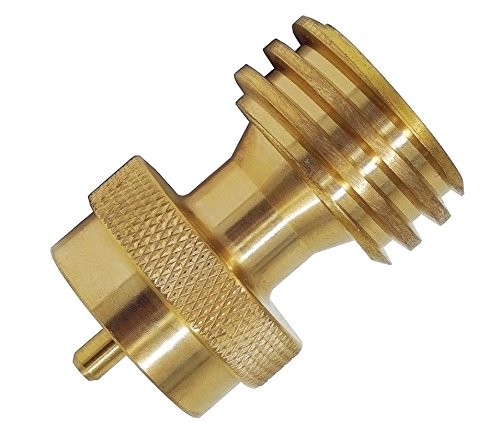
Mid-cook fuel loss is one of the most frustrating scenarios when searing steaks or entertaining family on the patio. When a primary bulk cylinder runs dry without a spare on hand, compact brass adapters can temporarily bridge the gap using standard one-pound disposable cylinders. The BEEDEFUL 1lb Propane Tank Adapter serves as a dedicated emergency converter, linking disposable one-pound camping canisters to standard grill hoses with QCC-1 and female POL fittings. Machined from solid brass with leak-resistant internal rubber seals, this compact adapter provides a fast way to finish cooking without rushing to an exchange kiosk.
Another reliable failsafe is the Steak Saver 1 lb to 20 lb Propane Tank Adapter, which connects directly to a grill regulator using ACME male and POL female threads. This solid brass hardware component allows outdoor cooks to attach a small green camping bottle when the primary container runs out. It is critical to follow proper installation sequencing with straight-through brass fittings by fastening the adapter securely to the appliance hose before threading on the pressurized fuel canister. Reversing the sequence during removal prevents accidental venting of propane vapor into the immediate workspace.
Connecting Tabletop Grills to Bulk Tanks Using Converter Hoses
Portable cooking equipment such as tabletop grills, camping stoves, and portable griddles is often engineered natively for disposable one-pound bottles. Operating these appliances exclusively on small canisters quickly becomes expensive and generates considerable metal waste during frequent outdoor meals. Upgrading the fuel delivery setup with a DozyAnt 4 Feet Propane Adapter Hose 1 lb to 20 lb allows cooks to draw fuel directly from bulk twenty-pound tanks. The assembly pairs durable solid brass terminal fittings with a heavy-duty reinforced rubber hose, delivering consistent line pressure across extended grilling sessions.
Cooks requiring additional positioning flexibility can select longer extension assemblies to keep bulk cylinders stationed safely away from the cooking perimeter. The 6 Feet Propane Hose Adapter 1lb to 20lb,Propane offers a weather-resistant PVC and braided cotton structure certified by CSA for outdoor appliance use. A slightly more compact variant, the 4ft Propane Hose Adapter 1lb to 20lb,Propane, provides reliable brass connectors designed for hand-tightened assembly without requiring hand tools. These adapter hoses connect seamlessly to popular tabletop appliances, eliminating reliance on short-lived disposable canisters.
Understanding OPD Valves, DOT Certifications, and Safety Inspections
Regulatory standards require all consumer propane tanks between four and forty pounds capacity to feature an Overfill Prevention Device, commonly known as an OPD valve. The OPD mechanism utilizes an internal float assembly that shuts off the intake flow once the cylinder reaches eighty percent liquid capacity, leaving necessary vapor space for thermal expansion. Cylinders equipped with an OPD valve are easily identified by their distinctive three-lobed triangular handwheel and clear external stampings. Refill facilities are legally forbidden from filling any consumer-sized cylinder that lacks this mandatory safety device.
Valves on modern propane cylinders also incorporate standard QCC-1 Type 1 external right-hand threads alongside traditional internal left-hand POL threads. The Type 1 connection incorporates a thermal shutoff feature and an excess flow safety valve that restricts fuel release if a hose ruptures or detects unusual flow surges. When shopping for replacement tanks or high-capacity vessels, always verify that the unit carries DOT certification stamps from the Department of Transportation or Transport Canada. These stamped marks verify that the steel cylinder underwent rigorous hydrostatic pressure validation and weld testing before entering commercial circulation.
Outdoor Cylinder Storage Rules and Vital Garage Safety Warnings
Transporting propane cylinders requires strict adherence to outdoor transport protocols to avoid hazardous vapor leaks inside passenger compartments. Propane containers must always remain positioned upright and secured firmly with cargo straps or milk crates in a well-ventilated vehicle bed or trunk. Leaving a cylinder on its side allows liquid propane to contact the pressure relief valve, potentially causing liquid discharge if ambient temperatures rise. Drivers should travel directly to their destination after filling or exchanging a cylinder, never leaving tanks inside a parked vehicle where heat can trigger safety releases.
Outdoor storage protocols are equally strict regarding spatial placement and clearances from residential structures. Propane tanks must never be stored inside a garage, basement, shed, or house, even during cold winter months or between cooking sessions. Storing a cylinder beside a built-in outdoor barbecue island requires open airflow and elevated placement on a non-combustible base away from ignition sources. Keeping tanks outdoors on a shaded, level surface protects the relief valve and prevents heavier-than-air propane vapors from accumulating near foundation vents or low-lying patio drains.
Critical Fire Safety and Carbon Monoxide Prevention Rules
Operating gas grills and managing propane fuel demands an uncompromising approach to outdoor fire prevention and ventilation. Under no circumstances should any gas grill or propane appliance be operated inside a garage, carport, enclosed porch, or interior living space, even with the overhead door wide open. Incomplete combustion of propane produces carbon monoxide, an odorless and colorless gas that accumulates rapidly in semi-enclosed structures and poses lethal poisoning risks. Grills also generate intense radiant heat that can easily ignite wall framing, ceiling rafters, or nearby household chemicals.
Safe grilling demands maintaining ample clearance from building exterior walls, vinyl siding, wooden deck railings, and overhanging tree branches according to local fire regulations and manufacturer guidelines. Cooks should always ensure that grease trays are inspected and cleared of debris prior to opening the tank valve. When preparing to light the burners, open the grill lid fully before turning the control knobs to prevent trapped gas pockets from causing dangerous ignition bursts. Prioritizing these foundational safety practices guarantees that patio meals remain enjoyable and secure.
Conducting Leak Tests and Verifying Fuel Seals Before Lighting
Verifying the integrity of all gas connections is an essential maintenance task whenever connecting a freshly refilled or newly exchanged propane cylinder. A simple soapy water solution applied across the valve threads, regulator fitting, and hose connection reveals hidden leaks immediately. If active bubbling develops around the brass junction when the tank valve is opened, an incomplete seal or worn rubber ring is permitting vapor escape. When bubbles appear, immediately turn the cylinder handwheel clockwise to the off position and disconnect the hose to inspect threads for dirt or damage.
Hoses and fittings also warrant frequent visual inspection for signs of ultraviolet degradation, brittleness, small animal chew marks, or structural cracking. Flexible rubber hoses that feel stiff or display surface weathering must be replaced promptly with certified assemblies to prevent sudden fuel loss during operation. Hand-tightened QCC-1 fittings should be threaded smoothly without cross-threading, ensuring the large plastic nut sits squarely against the tank collar. Maintaining clean valve threads and replacing aging regulator lines ensures consistent burner pressure and steady flame control across every outdoor cooking session.
Practical Sourcing Decisions for Reliable Backyard Grilling
Choosing where to procure propane ultimately balances immediate convenience against long-term fuel efficiency. Outdoor cooks who value quick swaps outside normal business hours benefit tremendously from neighborhood retail exchange kiosks, even if those tanks contain slightly less net fuel. Conversely, those seeking maximum burn time per tank visit and lower operational costs over time will find dedicated refill stations at hardware or farm centers to be the superior choice. Purchasing a dedicated new cylinder online and having it filled locally provides the cleanest, most dependable baseline for regular grilling.
Maintaining a redundant fuel strategy prevents the inconvenience of running out of gas midway through cooking dinner. Keeping a second certified twenty-pound cylinder stored safely outdoors allows an instant swap the moment the primary tank empties. Pairing this reserve system with versatile hardware, such as solid brass emergency adapters or extended bulk converter hoses, ensures that outdoor cooking remains seamless and adaptable. By understanding vendor options, equipment certifications, and safe handling guidelines, grillers can focus entirely on perfecting their recipes and enjoying outdoor meals.




Write Your Review
No reviews yet. Be the first to share your experience!